Alongside “social distancing,” a term that entered everyday conversation with COVID-19, another phrase is competing for prominence: the “new normal.”
What is this new normal and what does it mean for offices? What arrangements did public guidelines require, and what changes can maximize care in the workplace? When will a coronavirus vaccine be available? Will there be a second wave?
In this article we address the questions within our scope by compiling COVID-19 precautions and suggestions for offices. 😊
We Cannot Be as Close as Before!
After a break of about three months, we began returning to workplaces under the “new normal.” Some businesses returned to offices in June, while many remained hesitant. The new normal requires reconsidering many office standards accepted before the pandemic and makes some arrangements legally mandatory. Continuing with old habits and standards carries significant risk.
Office precautions and arrangements rest on three principles emphasized by experts from the beginning of the pandemic: social distancing, maximum hygiene and minimum contact!
The Ministry of Health issued a COVID-19 Outbreak Management and Working Guide setting minimum precautions. The guidance is available here.
Our first recommendation is to establish a company team to implement COVID-19 arrangements and inspect them regularly. Further suggestions follow below.
How Should Transport Be Arranged?
Although public transportation has precautions, a company that provided staff shuttles before COVID-19 would not normally be expected to switch to public transport during the pandemic. Many large employers split teams between the office and home to increase space per person and operate shuttles at half capacity. Transport precautions include:
- Plan shuttle occupancy within the prescribed limits.
- Require masks during travel.
- Disinfect vehicle interiors regularly, at least weekly.
- Disinfect shared pool vehicles regularly.
How Should We Welcome Employees and Visitors?
Precautions starting at the entrance to the building or office are important to reduce transmission risk. Suggested entrance and reception measures include:
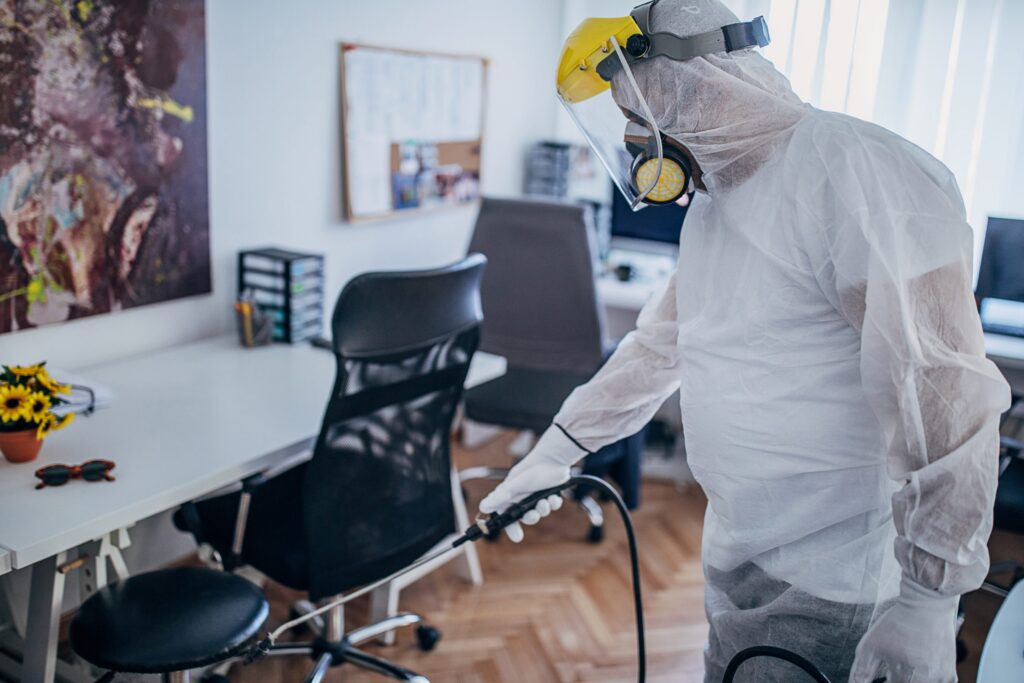
- Disinfect offices and shared areas before employees return.
- Establish entrance, reception and wayfinding procedures.
- Train reception and security staff on COVID-19 measures and procedures and conduct practice exercises.
- Install turnstiles for controlled entry.
- Place hygiene mats at entrances.
- Display information for employees and visitors in reception areas.
- Provide social-distancing directions.
- Measure body temperature on entry manually or using suitable automation.
- Arrange lobbies and waiting areas to meet physical-distancing standards.
- Set up appropriate disinfection stations at entrances.
- Provide mask and glove dispensers for visitors and staff, including masks for those without one.
How Can We Implement and Communicate Social Distancing?
After the pandemic began, printing, advertising and plastics companies developed distancing signs and barriers: labels, floor strips, warning boards and partitions. Such visual warnings and barriers can help employees and visitors maintain distance. Our suggestions include:
- Plan staff and customer numbers at one person per four square meters.
- Place information posters in prominent and shared areas.
Ready-made Ministry of Health posters are available here.
- Mark at least 1.5 meters of distance at reception counters.
- Place easily positioned plexiglass partitions on reception counters to reduce interaction.
- Apply distancing floor labels in corridors and shared spaces.
- Arrange shared workstations to maintain employee distancing.
- Use distance markers where queues can form, such as beverage counters and vending machines.
How Should Shared Areas Be Used?
Even with distancing in general work areas, extra precautions are needed in relatively small, heavily used toilets, washrooms, dining rooms, prayer rooms, smoking areas and meeting rooms:
- Rearrange dining seating to maintain at least one meter between employees.
- Serve food and bread in single-use packages.
- Use disposable paper or plastic cups.
- Remove shared salt and pepper shakers and use packets.
- Check dining-room exhaust and fresh-air lines for airtight operation at full capacity.
- Place sanitizer dispensers at dining-room entrances.
- Separate dining-room entrances and exits if possible.
- Use alternate toilet cubicles where possible.
- Increase toilet cleaning frequency and clean with bleach at least every 30 minutes.
- Provide cleaning staff with coveralls, gloves, masks and safety glasses.
- Check toilet exhaust and fresh-air lines for airtight operation at full capacity.
- Do not operate air hand dryers; provide disposable paper towels.
- Close toilet lids before flushing and, where possible, install a mechanism that prevents flushing until the lid is closed.
- Keep floor drains filled with water so they do not dry out.
- Place sanitizer dispensers and hygiene mats at toilet entrances.
- Limit numbers at communal worship, require masks and maintain distancing.
- Require worshippers to bring and use their own prayer mats.
- Ventilate prayer rooms after each service.
- Check prayer-room exhaust and fresh-air lines for airtight operation at full capacity.
- Mark usable seats in shared smoking and rest areas.
- Limit spaces where people can gather even outdoors.
- Set occupancy limits for such areas.
Offices Are Sweltering: When Can Air Conditioning Be Turned On?
During the hot pandemic summer, not being able to use air conditioning was difficult. The original article noted that, although scientific research on the effect of air conditioners on COVID-19 spread had not been presented, experts and public authorities initially took a strict position against units recirculating room air. The Chamber of Mechanical Engineers’ July 6, 2020 office precautions text conditionally permitted air conditioning with certain measures. Read the full statement here.
Suggested ventilation and air-conditioning measures were:
- Run all air-handling units, with or without mixed air, on 100% fresh air.
- Do not use rotary heat-recovery units because of the risk of air mixing.
- Use suitable HEPA or UV-C filtration at fresh-air intakes.
- Use room air cleaners meeting international standards, especially in shared workspaces.
- Use suitable HEPA filters on units recirculating room air, taking fan pressure into account.
- Fix air-circulation directions and reduce fan speeds.
- Provide detailed maintenance before restarting equipment that has been idle and periodically for equipment in use.
- Clean filters regularly, at least monthly.
- Maintain indoor humidity between 40% and 60%.
- Run toilet exhaust fans continuously, 24/7.
Our Seas Are Filling with Masks and Gloves. How Can We Manage Waste?
Many people are careful to wear masks and gloves but fail to dispose of single-use hygiene products correctly. Mask and glove litter has increased in parks, gardens and even the sea. The Ministry of Environment and Urbanization issued a circular requiring disposable COVID-19 protection materials to be disposed of to medical-waste standards: the circular.
The following steps can protect both personal and environmental health:
- Collect disposable personal protective equipment separately from other waste.
- Dispose of disinfectant containers according to their labels.
- Place gray lidded containers marked “Waste Masks and Gloves” in common areas and office floors.
- Assign specially trained personnel to empty containers and temporarily store the waste.
- Collect waste in drawstring bags used once and never emptied; avoid touching waste while transporting it.
- Ensure temporary storage is out of direct sunlight, away from shared areas and protected from animals and pests.
- After holding waste in temporary storage for at least 72 hours, hand it to municipal collectors with household waste but in separate bags.
Measures based on social distancing, maximum hygiene and minimum contact can be expanded further, but we conclude here. For professional support with these and other arrangements, Servis365 can visit your office and plan precautions together. Your health and that of your employees are part of the health of the community.